10+ Minimalist Living Room Designs Inspired by Chinese Culture and Architecture
Minimalist design in China isn’t just about clean lines or neutral tones — it’s about intention. Every beam, brushstroke, or empty corner carries meaning. After years wandering through renovated alleyway homes in Shanghai, lakeside studios in Dali, and quiet balcony lounges overlooking the South China Sea, I’ve come to believe that the most powerful living rooms are often the most silent. Not empty, but calm.
These are spaces built on rhythm, not trends — where modern simplicity meets centuries of cultural wisdom. What follows isn’t a checklist of décor tips. It’s a journey through 10+ living rooms across China that blend tradition, nature, and minimalist architecture into spaces you don’t just see — you feel.
Suzhou Garden Flow in a Modern Living Space
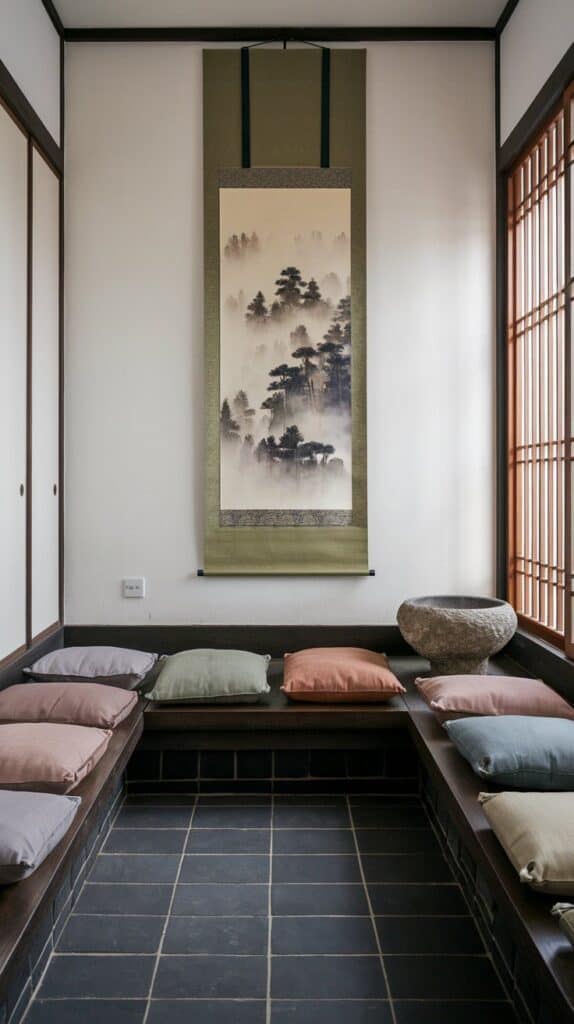
There’s something about the way Suzhou gardens use emptiness as much as they use form. In one particular home just outside the old city, I walked into a living room that felt like an architectural haiku. A simple L-shaped bench made of unfinished elm sat low against a rice-white wall. The cushions were thin, textured like handmade paper, and colored in muted mineral tones — not beige, not gray, something between.
Behind the bench, a single horizontal scroll painted with a scene of mist-covered pines stretched across the wall, but it was intentionally hung higher than expected, forcing your gaze upward. That vertical space, left empty, felt as curated as the artwork itself. The floor was tiled in matte charcoal clay, cool underfoot and grounding in presence. One small indoor stone basin — not quite a fountain, not quite decor — was tucked beside the window where it caught afternoon light and the occasional falling leaf. This wasn’t a living room in the Western sense.
It wasn’t meant for entertaining guests or showcasing a style. It was a place to settle the mind. And what struck me most was how the proportions echoed the logic of classical Chinese garden design — layers, framed views, negative space, and a careful choreography of light and material. There’s no sofa, no television, no storage wall. Just a feeling of stillness, as if the entire room had taken a breath and held it there for you.
Nordic-Style Longtang Flat in the Heart of Shanghai
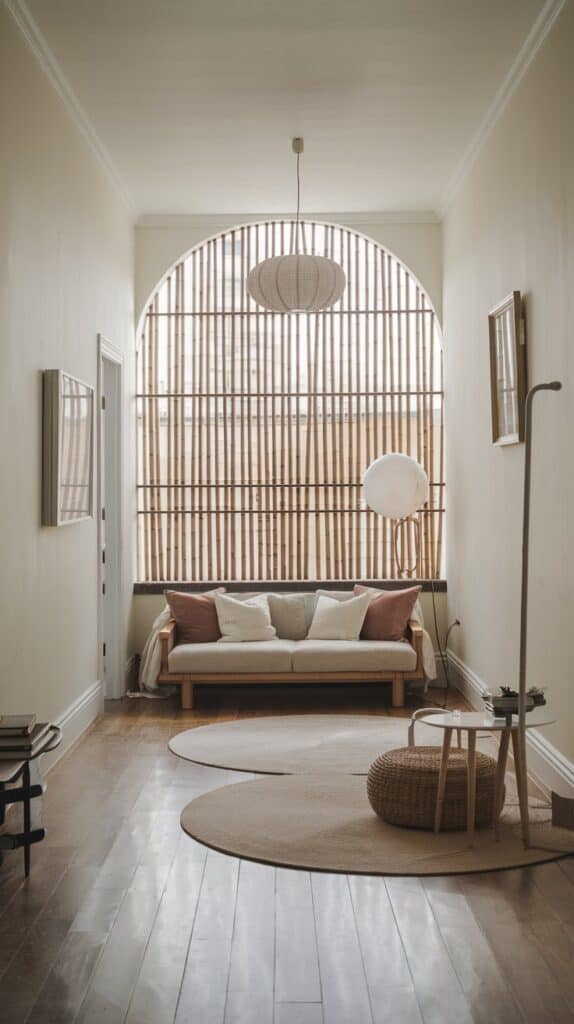
Inside a 1930s longtang house in Xuhui, a young designer has carved out a two-room apartment where east quietly meets north. The main living space is narrow, yet it feels expansive because of how little it insists on doing. The floors are pale ashwood, unvarnished and creaky in all the right places. The original brick walls were plastered over and repainted in soft ecru, giving the whole room a milky warmth.
What’s interesting is that she didn’t install any overhead lighting. Instead, there’s a floor lamp shaped like a moon — a literal sphere on a bent brass stem — that casts an amber glow across the corner. The sofa is Scandinavian in build — low-slung, tightly upholstered in ivory cotton — but it’s pushed right into a carved wood alcove that used to be part of a built-in altar. That single gesture changes everything. It transforms the space from a display into a dialogue between time periods.
She’s placed a bamboo lattice over the front window, filtering sunlight into faint lines like old shuttered houses used to do. Instead of artwork, a dried branch sits in a matte black ceramic vase — and nothing else. No books, no candles, no clutter. What really makes the space breathe is the decision to leave the back half of the room empty. Literally just space. Enough to roll out a mat, stretch, pour tea, or stand in silence. And in a city like Shanghai, where real estate pressure pushes people to fill every corner with something useful, that choice feels radical.
A Calligrapher’s Retreat in Hangzhou’s Lakeside District
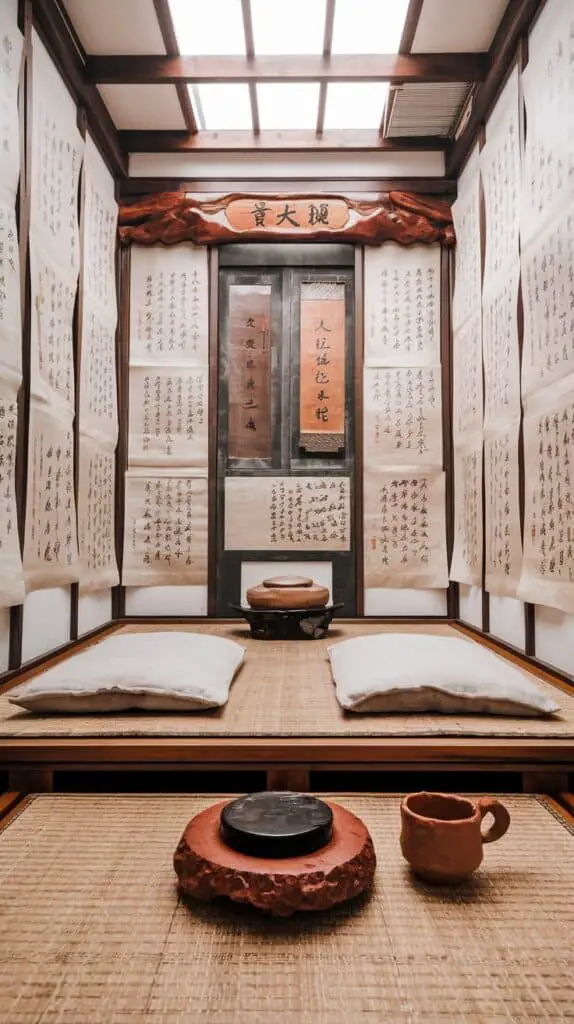
The air in Hangzhou has a softness that tends to soak into its interiors, and nowhere is that more evident than in a calligrapher’s home I visited near West Lake. His living room, if you can call it that, was more of an intentional pause between rooms. There was no defined sitting area — just a slightly sunken floor with clay tiles, a low bench beneath a wall of unframed rice paper sheets, and a single beam of light spilling down from a narrow skylight. A handmade inkstone rested on the floor beside a rough clay teacup.
No sofa, no chairs. Just two linen meditation cushions and a flat platform made from reclaimed poplar wood. The space smelled faintly of ink, sun-dried herbs, and old paper. He told me he used the room not for hosting or watching TV, but for watching shadows. I didn’t fully understand until I saw it around 4 p.m., when the sun slipped through the skylight and painted a crisp silhouette of the pine tree outside across the wall.
That’s what this room was made for — a theatre of natural rhythm. The ceiling sloped slightly, drawing the eye to a carved wooden beam with a single phrase etched into it: 静心 — quiet mind. It made sense. The whole space was a study in restraint. And while it wouldn’t make the cover of a design magazine, it stays with you. Not for how it looked, but for how it felt to sit in silence there.
Minimalist Feng Shui Loft in Guangzhou
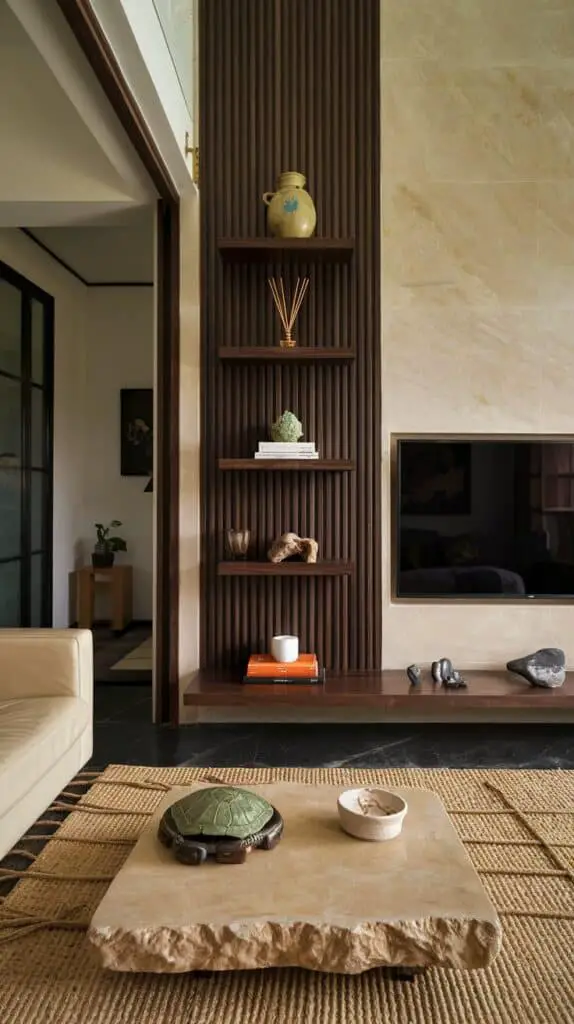
Up in one of the newer apartment towers on the edge of Guangzhou’s CBD, there’s a loft where every design choice follows feng shui — but you wouldn’t know it unless someone told you. It doesn’t scream mysticism. It just feels… balanced. The entry opens into a small but high-ceilinged living room, where a cream-toned couch backs against a solid wall, grounded by a rectangular stone slab as a coffee table. Nothing is placed directly in the path from the door to the window — it’s clear, open, and welcoming.
On one side, a vertical shelf carved from dark walnut runs floor-to-ceiling, holding no more than six objects: a water pot, a reed diffuser, a stack of poetry books, a jade turtle, a white ceramic dish, and a stone from the Li River. That’s it. No art, no branding, no labels. The television is hidden in a pivoting panel, and the rug is just a natural sisal mat, tied loosely with twine to hold its edges.
The whole palette is natural: sand, charcoal, muted greens. But it’s the positioning of objects that creates peace. The room doesn’t fight itself. Each piece is quiet, functional, and placed with intention. It makes you think about your own living space and what’s truly necessary for comfort — not in terms of things, but in terms of flow.
Bamboo-Screened Balcony Lounge in Wenzhou
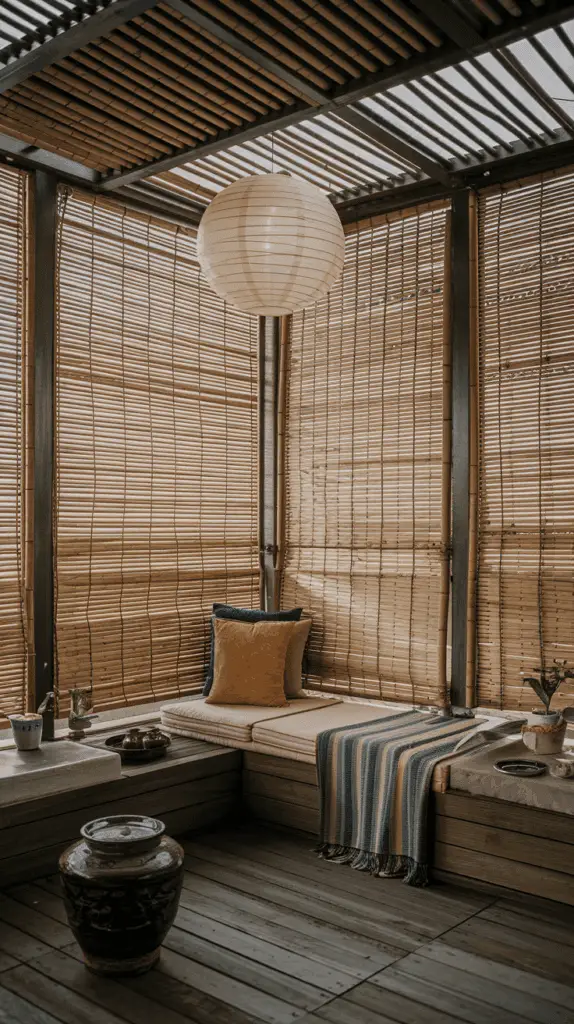
In a coastal apartment tucked into the newer blocks of Dongtou Island, I spent a rainy weekend watching the sky roll in from a narrow bamboo-screened balcony that had been completely reimagined as a living room. It was no more than two meters wide, really just a sunroom by standard definitions, but it was the soul of the home.
A platform bench lined the window-facing wall, topped with two hand-stitched linen cushions and a single soft wool blanket folded with care. The furniture was nothing more than a low tea table — slightly worn, carved from local cypress — and a single ceramic stool in moss green, doubling as a book stand. The ceiling, once concrete, had been overlaid with slatted pine, and a round paper lantern dangled gently like a cloud in midair. But the magic came from the bamboo shades that dropped from ceiling to floor, transforming harsh daylight into golden haze.
They creaked softly in the wind, like a song. The space didn’t try to be a living room in the Western sense — no TV, no sofa, no clutter — just a place to breathe and sip tea while the world outside blurred into fog. In the evenings, a woven lantern lit the floor with soft shadow rings, and the quiet wrapped around you like a second skin. It was the smallest living room I’d ever seen. It was also the most complete.
Minimalist Tea Lounge in a Chengdu Apartment
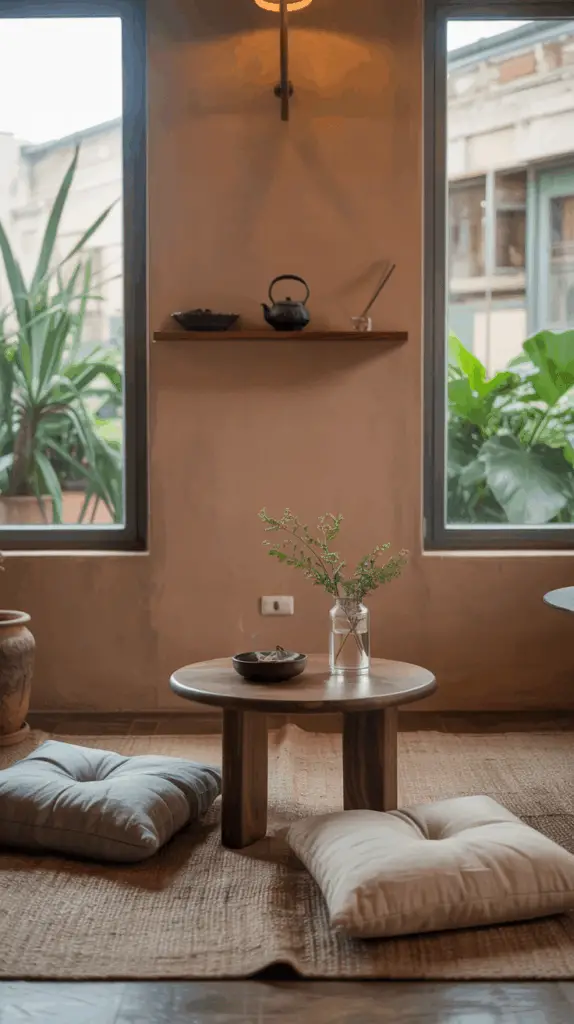
The homes in Chengdu tend to carry a kind of softness — not in shape, but in attitude. One apartment I visited just off Taikoo Li had abandoned the idea of a living room altogether. Instead, the owners — a couple in their early thirties — had laid down four floor cushions, each wrapped in thick raw cotton, around a single low tea table carved from local walnut.
That was it. No couch, no media wall, just a horizontal space that welcomed you to slow down. The walls were plastered smooth in a clay wash that changed color with the hour — amber at sunrise, dusty rose by dusk. A pair of floating shelves held only the essentials: two tea caddies, a brush pot, a miniature incense bowl in celadon glaze, and a stack of sun-faded poetry books. A woven hemp rug covered most of the floor, its edges fraying just enough to feel lived-in. There was no dominant color.
Only tones — clay, wood, paper, breath. The windows opened outward toward a narrow courtyard, letting in scents of magnolia and rain. When I sat cross-legged on the mat with a cup of pu-erh, it felt like time folded into itself. Not a designed moment, but a lived one. The kind of space that doesn’t ask you to admire it — just to be still inside it.
A Monastery-Inspired Living Room in Xi’an
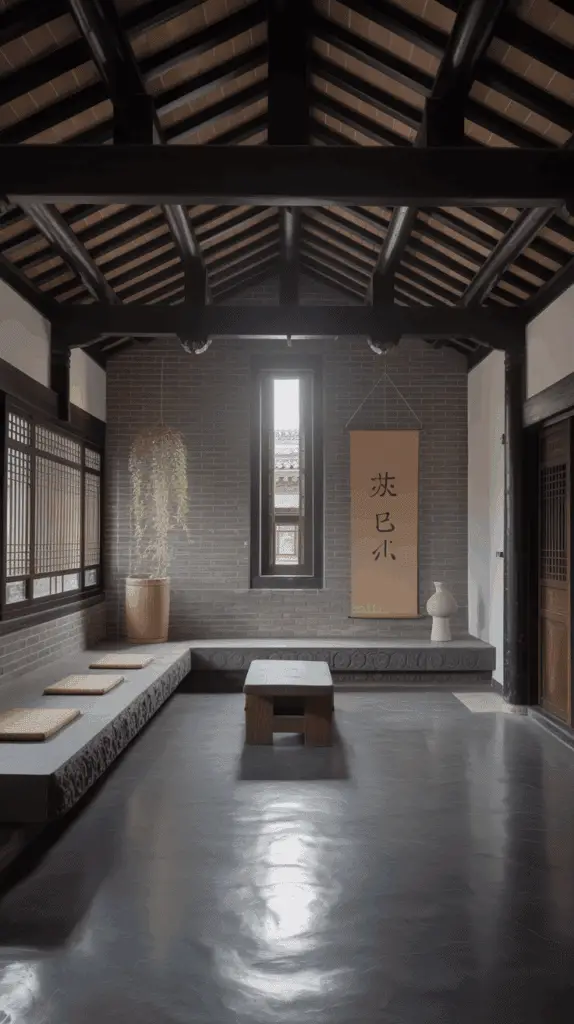
Just outside the old city wall in Xi’an, there’s a converted residence that once formed part of a temple complex. The new owners, a pair of architects from Guangzhou, preserved the bones of the structure while rethinking the interior as a kind of sacred silence. The living room sits beneath a pitched roof with hand-hewn beams and clay-tiled eaves, and it’s clear from the first step inside that this space was designed for breath, not broadcast. There is no central couch.
No art. No shelves. Just a long stone bench carved from a single slab of dark gray basalt, softened by folded linen mats and one simple bamboo backrest. The floor is made of compressed earth, sealed and polished smooth like lacquered leather. Light pours in through a high vertical window, placed deliberately to catch sunrise but never glare. In the far corner, a hanging scroll inscribed with the character “心” — heart — swings gently with the draft. When you sit in the room, facing that scroll, time drops away.
You feel it in your bones — the weight of things left unsaid, the power of simplicity not as style, but as discipline. The architects told me they called it a pause room, not a living room. And that phrasing still echoes in my memory.
Double Happiness in a Newlywed Home Near Ningbo
In a newer housing development just outside Ningbo’s historic district, I met a young couple who had just finished setting up their first shared apartment — a two-bedroom space with views over a small canal and willow trees.
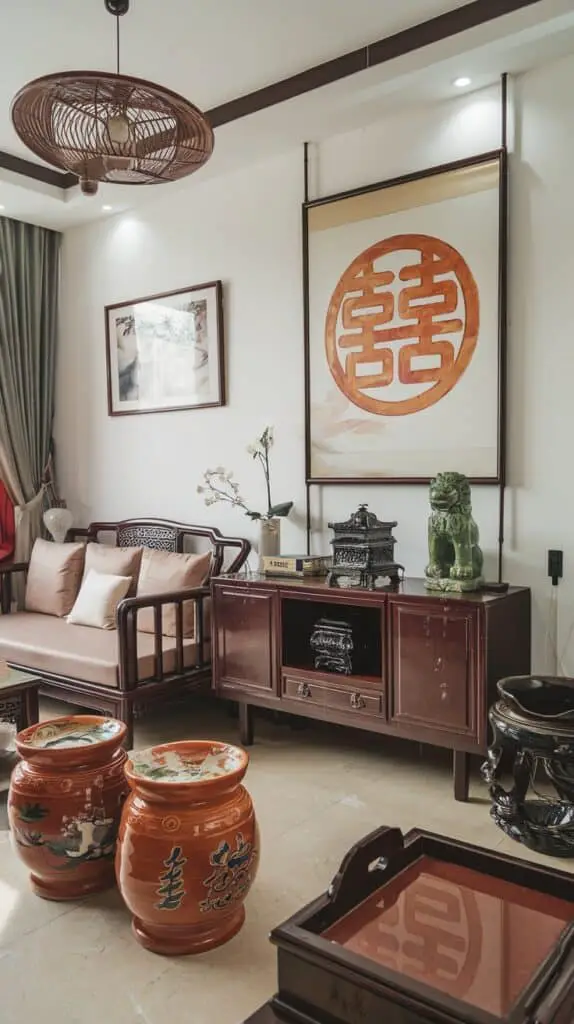
Their living room was a gentle act of restraint, grounded in cultural tradition without becoming decorative. The centerpiece wasn’t the couch — it was the painting above it: a modern reinterpretation of the traditional double happiness symbol, brushed in bold red on a coarse linen canvas. It was the only saturated color in the room.
The sofa was low and soft, upholstered in pale oatmeal linen, with clean wooden arms and a single textured throw. No coffee table — just two cylindrical ceramic stools that could shift depending on need. Along one wall, a floating sideboard held a wedding photo, a jade figurine of a lion, and a black clay incense burner. But beyond the objects, what struck me most was the way they left one full corner of the room completely bare.
When I asked why, they smiled and said it was for “the future” — for dancing, for a crib, or just for nothing. A place that could become whatever it needed to. There was wisdom in that empty space, and it made me think that maybe love, too, needs room to breathe.
Floating Minimalism in a Dali Guesthouse
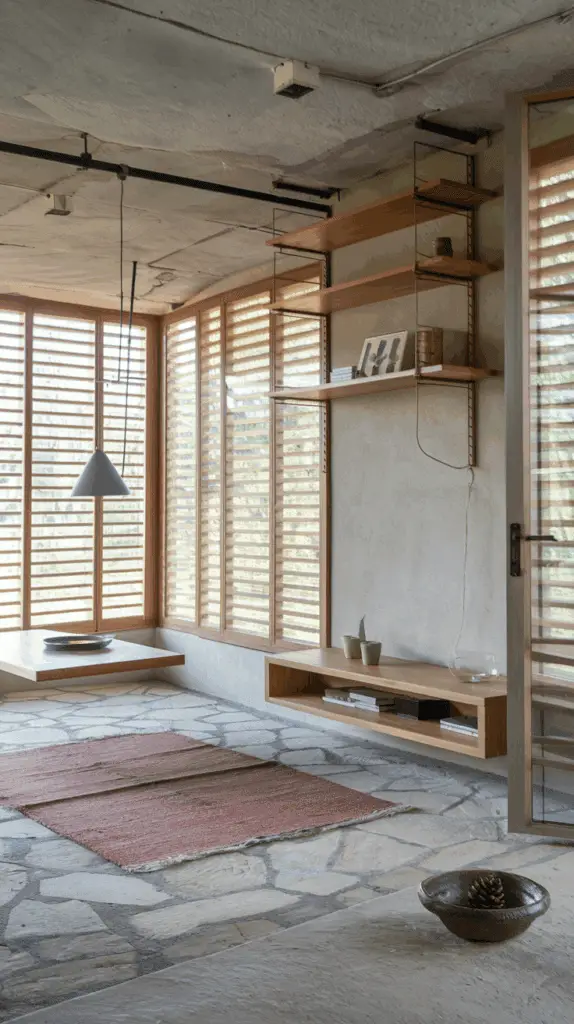
Dali, high in the Yunnan mountains, has a way of stripping things down to their essence. In a quiet guesthouse near the edge of Erhai Lake, I found a living room that barely touched the ground — everything in it seemed to hover. The floor was stone, cool and irregular, and most of the furnishings were wall-mounted: a suspended oak shelf that doubled as a bench, a floating table, a cantilevered lamp.
Even the rug — a faded wool rectangle from Tibet — was mounted slightly above the ground on a platform of compressed bamboo. The windows were floor-to-ceiling on two sides, framing rice paddies and slow-moving clouds, and there were no curtains, only slatted pine shades that could be tilted like pages. The ceiling was raw concrete, left unfinished, but softened by three paper lanterns that glowed like moons. The only ornament in the room was a pinecone resting in a ceramic bowl.
That pinecone had fallen from the tree just outside the door, the host told me. They had placed it there a year ago, and never moved it. That kind of thoughtfulness — not as design, but as gesture — was everywhere. The space didn’t ask you to notice it. It simply held you, like air.
Final Thoughts
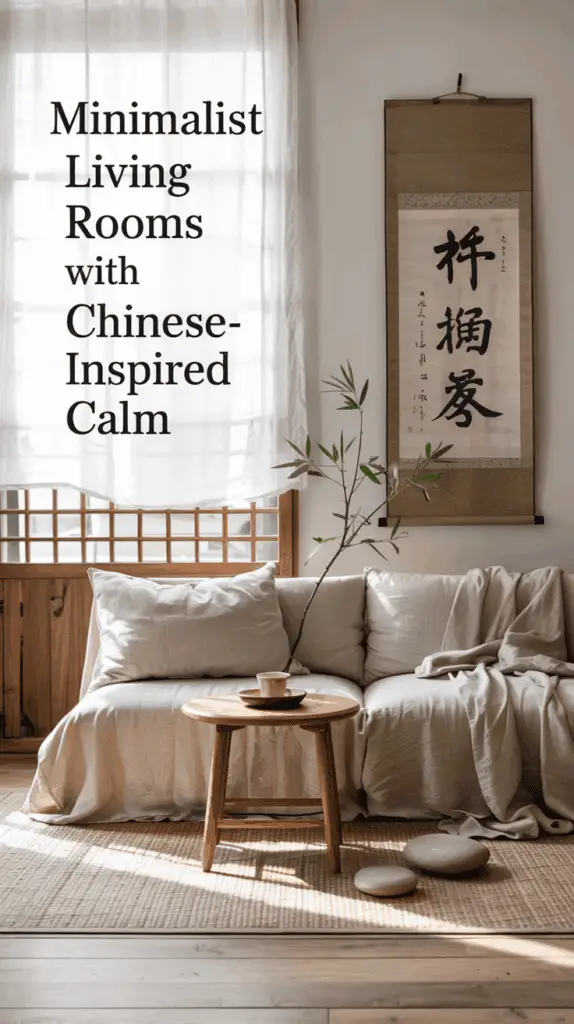
In all my travels through China’s homes — from tiny island balconies to ancient monastery rooms — the same idea keeps returning: the most powerful living rooms are the ones that do the least. They don’t demand attention.
They don’t beg for compliments. They simply make space — for air, for stillness, for life. And in that space, something begins to grow: clarity, rhythm, peace. Minimalism here isn’t cold. It’s rooted. It listens. And maybe that’s the real lesson — that a living room doesn’t need more to feel whole. It needs less, done with care.